
Why blended finance now funds half of African startups
Debt and structured capital rose 128% in two years and now outweigh equity on the continent. What drove it, whether it lasts, and what it means for your next raise.
The shift, in one chart
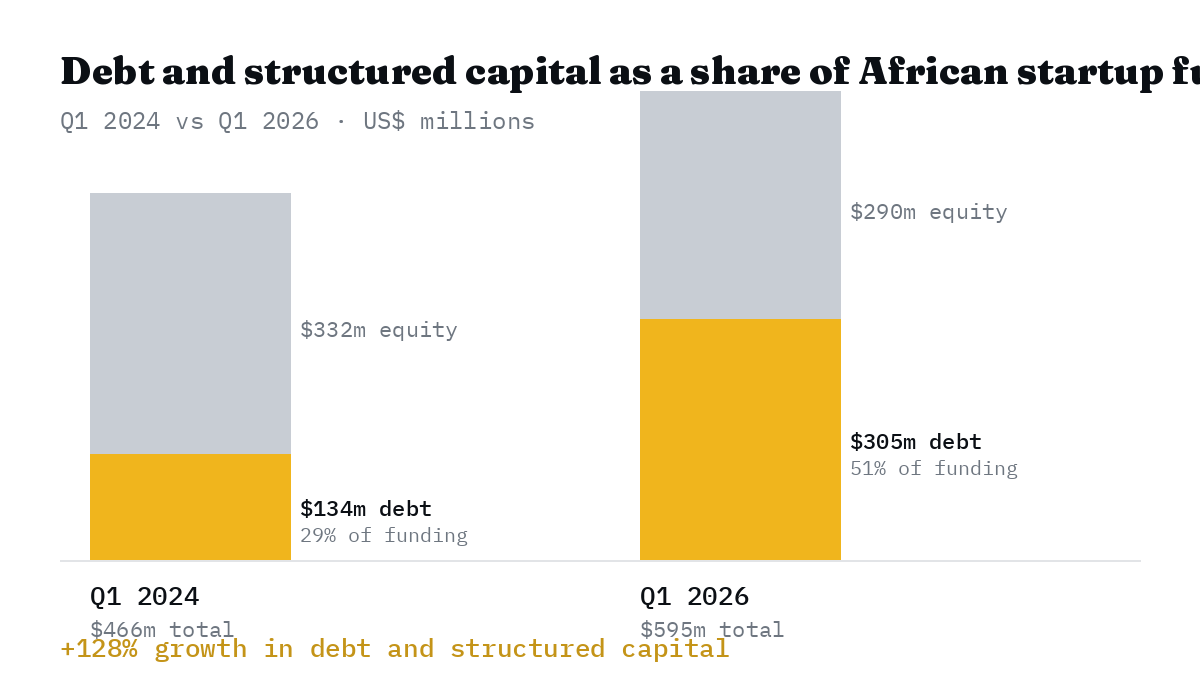
Two quarters, two years apart. In Q1 2024 African startups raised $466 million in total, of which $332 million was equity and $134 million was debt. In Q1 2026 the debt side alone reached $305 million against roughly $290 million of equity — the first time non-equity capital has outweighed equity across a full quarter.
One clarification worth making, because precision matters when the numbers are this striking: the underlying series tracks debt and structured capital as a whole. Blended structures — concessional development capital combined with commercial money in a single transaction — are the dominant driver within that category rather than the entirety of it. The direction and the scale of the shift are not in question; the label is broader than blended finance alone.
Why equity retreated
The first half of the story is not about debt at all. Global venture capital repriced sharply from 2022, and African equity felt it harder than most markets for three compounding reasons.
Exit routes stayed thin. Venture equity is priced off the exit, and the continent’s exit record — a small number of trade sales, almost no listings — gives funds little to underwrite against. When global risk appetite tightened, the markets with the least proven exit paths were cut first.
Currency risk sits on the equity holder. A dollar fund taking equity in a rand, naira or cedi business absorbs the full depreciation between entry and exit. Over a seven-year hold in several African currencies, that has been enough to erase an otherwise successful investment.
Valuations from the 2021 peak took years to clear. Founders anchored to 2021 pricing; investors would not meet it. Rounds did not close, they simply did not happen, and businesses that needed capital in the meantime looked for another instrument.
Why debt and blended structures filled the gap
The second half is more interesting, because the growth is not simply equity’s loss redistributed. Debt into African startups nearly tripled in absolute terms while total funding moved far less. Something changed on the supply side.
Development finance institutions scaled up deliberately. DFIs have mandates measured in jobs, industrial capacity and inclusion — not in fund vintages — and they are counter-cyclical by design. As commercial equity withdrew, institutions like the IDC, the NEF and their continental peers had both the capital and the instruction to lean in.
Guarantees changed what commercial lenders could price. A first-loss tranche or a partial guarantee from a development institution transforms a transaction a commercial bank would decline into one it can approve. That is the mechanic doing most of the work in these numbers: one rand of concessional capital pulling several rands of commercial capital into a deal that would otherwise not have existed.
More African businesses became debt-fundable. A wave of companies founded between 2018 and 2021 now has real revenue, real receivables and real assets. Debt requires predictable cash flow; a maturing cohort simply has more of it than the same cohort did four years ago.
Founders did the arithmetic. Debt at a real interest cost is frequently cheaper than equity sold at a depressed 2024 or 2025 valuation. A founder who financed working capital with debt through the trough kept ownership that an equity round at the bottom would have permanently transferred.
What this means if you are raising
The practical implication is not “raise debt instead of equity”. It is that the instrument question now comes before the pitch, and getting it wrong costs more than it used to.
Match the instrument to the constraint. Financing a receivable, a purchase order or a piece of equipment is a debt problem — the cash flow to service it already exists. Financing genuine risk with no predictable repayment behind it — product development, market entry, a new category — is an equity problem. Raising equity for a working-capital gap is the most common and most expensive mistake in this market.
Expect to be assessed like a borrower. Blended and development capital assesses commercial soundness and development outcome together. That means historic financials that reconcile, projections that survive stress, and a clear account of what the money buys and how it comes back. It is a higher documentary bar than an equity deck, and a lower one on growth rate.
Sequence the raise. Many of these structures require the sponsor to bring something — owner contribution, a first-loss layer, or a commercial lender alongside the concessional tranche. Working out who moves first is most of the execution, and it is where processes stall.
Our guide to how blended structures actually work sets out the mechanics, and our overview of development finance institutions in Africa maps which institutions fund what at which size.
Is this permanent, or is it the cycle?
Honest answer: partly both, and the distinction matters for how you plan.
The cyclical part is real. If global rates fall and African exits improve, equity will return and its share will recover. Some of the 51% is equity’s absence rather than debt’s arrival, and a single quarter is a thin basis for declaring a permanent regime change.
But the structural part looks durable. The guarantee and first-loss machinery now in place does not unwind when rates fall — institutions have built teams, products and track record around it. The cohort of debt-fundable African businesses keeps growing. And founders who have now seen what dilution at a trough valuation costs are unlikely to forget it in the next cycle.
The reasonable expectation is not that debt stays above half indefinitely, but that the African capital stack is permanently wider than the equity-only model most founders were taught to pitch into. That is the change worth planning around.
Where Caban fits
We work on both sides of this. Our corporate finance desk structures blended and development-finance transactions for African businesses — matching the instrument to the constraint, preparing the case to the standard these funders assess against, and sequencing the raise so the concessional and commercial layers land in the right order. We also invest our own capital in this market, which is why the advice comes from a principal’s seat rather than a spectator’s. If you are weighing debt against equity for a specific raise, that is a conversation worth having before the pitch deck, not after.
Questions, answered
How much did blended finance for African startups grow?
Debt and structured capital into African startups rose from $134 million in Q1 2024 to $305 million in Q1 2026 — growth of 128%. Over the same period its share of total startup funding rose from 29% to 51%. Source: Africa: The Big Deal, transactions of $100k+, excluding exits.
What is blended finance?
Blended finance combines concessional capital — typically from a development finance institution, at below-market terms or in a first-loss position — with commercial capital in a single transaction. The concessional layer absorbs risk that a commercial lender or investor will not take, which makes the overall deal financeable.
Why is debt replacing equity for African startups?
Both sides moved. Equity retreated because exit routes stayed thin, currency risk sits with the equity holder, and 2021 valuations took years to clear. Debt grew because development finance institutions scaled counter-cyclically, guarantees let commercial lenders price deals they would otherwise decline, more African businesses became debt-fundable, and founders found debt cheaper than equity at depressed valuations.
Should I raise debt or equity for my business?
Match the instrument to the constraint. Financing receivables, purchase orders or equipment is a debt problem — the cash flow to service it already exists. Financing genuine risk with no predictable repayment behind it is an equity problem. Raising equity to cover a working-capital gap is the most common and most expensive mistake in this market.
Will equity funding return to African startups?
Probably in part. If global rates fall and exits improve, equity's share should recover — some of the current 51% reflects equity's absence rather than debt's arrival. But the guarantee and first-loss machinery built over the last two years does not unwind when rates fall, so the African capital stack is likely permanently wider than the equity-only model.